
NIERA’s Week at the 5th Tanzania MEL Conference
Every September, Tanzania’s monitoring, evaluation and learning (MEL) community gathers in Arusha for MEL Week. The 5th edition ran from 22 to 26 September 2026 at Ngurdoto Mountain Lodge, drawing practitioners from government, donor agencies, academia and civil society from across the country and beyond. The Network of Impact Evaluation Researchers in Africa (NIERA) was there on two fronts: a masterclass on technical MEL skills, and an exhibition booth that stayed busy all week.
The masterclass: From Data to Decisions
On Tuesday 22 September, NIERA delivered From Data to Decisions, a masterclass on technical skills in evaluation, data management and participatory methods. It was open to practitioners at every level – government, NGO, donor, researchers and academicians. Jennifer Nyakinya, NIERA’s Director of Programs, opened the session with an introduction to NIERA’s work, setting the tone for what followed. The session itself was facilitated by Mr. Zakayo Zakaria, Tanzanian-based NIERA member with support from Dr. Jaah Mkupete in developing the session’s materials.
Zakayo framed the session around a single question: can decision-makers trust the evidence we put in front of them? His answer, in a word: not automatically. “Good analysis cannot rescue bad data,” he told participants – evidence has to be credible (accurate and traceable), timely (it has to reach decisions when they matter) and usable (non-technical audiences have to be able to act on it). He also emphasized that data management isn’t “cleaning at the end” – it’s a chain of decisions running the length of the evaluation lifecycle (plan, collect, check, manage, analyze, communicate, act), where a weak link anywhere can change the story an evaluation tells.
The centerpiece was a live walkthrough: a mock field dataset of ten households, checked against five questions that should run every day in the field – completeness, missingness, outliers, consistency and enumerator patterns. Within minutes the group had spotted a respondent recorded as 187 years old, a household missing its size (a key poverty-targeting variable), a household reporting zero income despite being employed, and an enumerator whose last two interviews ran suspiciously short – the kind of problems a daily habit of looking catches before they reach analysis. Zakayo closed the session with a simple way to turn findings into something decision-makers can act on – finding, confidence, equity, action – and a line that captured the morning: trustworthy evidence is designed, not discovered.
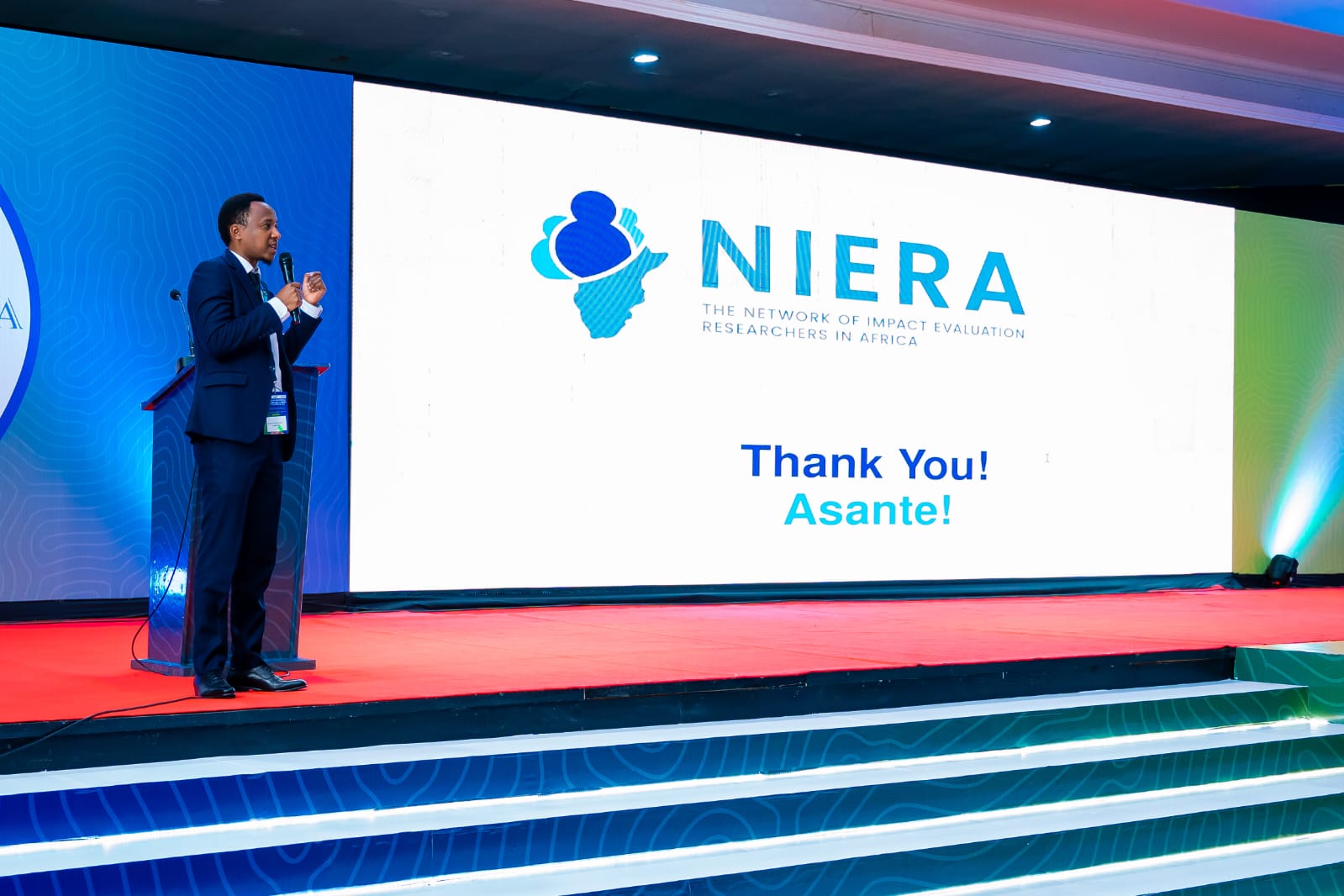
At the booth: conversations that kept going
Outside the session rooms, the NIERA exhibition booth drew visitors all week, staffed by NIERA’s Program Officer and Tanzania-based members. The booth was an opportunity to describe our work ranging from the Peter Da Costa 2.0 Prize to NIERA’s research, membership and the upcoming NIERA Impact Academy. One of the week’s highlights came when the Deputy Speaker of the National Assembly of Tanzania stopped by with his delegation. NIERA Program Officer Mr. Derick Oluoch briefed them on NIERA’s mission and its work advancing decision-focused evaluation across Africa.
Why it matters
Tanzania has a growing MEL community, and growing demand for evaluators who can move fluidly between evaluation design, data management and the practical work of getting evidence in front of decision-makers. NIERA’s Tanzania-based members designed and led the masterclass themselves — a reminder that the network’s work in the country is driven locally, by people who understand its evaluation landscape from the inside.
We thank the Tanzania Evaluation Association (TanEA) and the MEL Week organisers for hosting NIERA at the 5th Tanzania MEL Week. Special thanks go to Mr. Zakayo Zakaria for facilitating the masterclass, Dr. Jaah Mkupete for his work developing the session materials, and Dr. Christina Fille, all of whom gave their time and expertise to make NIERA’s presence at MEL Week a success.
To find out about NIERA’s work and Impact Academy, explore our website: www.nieraglobal.org or email info@nieraglobal.org.